

Three island names come up in every Thailand wind sport conversation. They’re not interchangeable, and treating them as roughly equivalent options is one of the more reliable ways to book the wrong trip. The wind seasons differ. The water types differ. And the gap between a shallow, boat-free learning lagoon and a busy resort beach with chop and traffic is the difference between a productive week on the water and a frustrating one.
From kitesurfing on Koh Phangan to Samui’s polished resort scene to Phuket’s Andaman power — each island has a genuine case to make. The comparison below runs through the factors that actually matter when you’re planning a kite or wing foil trip: wind consistency, water type, crowd level, school infrastructure, price, and the overall atmosphere you’ll be riding in.
Koh Phangan: the case for flat water and space
This island sits in the Gulf of Thailand, and its geography works unusually well for wind sports. The west-facing lagoons around Thong Sala Beach are sheltered, shallow, and sandy-bottomed. No reef hazards in the main learning zones. Water depth in the practice area runs waist to chest-high across a wide flat stretch, which means falls are low-consequence and resetting between attempts is quick. For first-timers, that’s not a minor detail — it’s what makes 3-day progress realistic rather than aspirational.
The wind follows two reliable seasons. November through April brings the northeast monsoon: steady, typically 12 to 18 knots, consistent enough to build sessions around. July through September sees the southwest wind arrive, stronger and suited to riders looking for more power once the basics are locked in. For wing foil on Koh Phangan specifically, the North-East monsoon creates some of the most consistent flat-water foiling conditions in Southeast Asia — the kind of long, predictable sessions where a student can genuinely internalise the feel of the foil rather than spending half the time waiting for the next puff.
Crowd levels are low by Thai island standards. Wide open spaces, minimal boat traffic through the riding zone, and a pace on the beach that doesn’t feel rushed. For kiteboarding and wing surfing, that translates into more water per rider, less pressure during the learning phase, and a noticeably different atmosphere from the beaches further down the tourist trail.
Kite Club on Koh Phangan operates on Thong Sala beachfront with both IKO and IWO certification — the only setup on the island covering both disciplines officially. The team is multilingual across English, Russian, Arabic, German and Ukrainian, which matters when a coaching correction needs to land quickly and clearly. Showers, Wi-Fi, a lounge area, beachboy service, and gear storage are all on site.
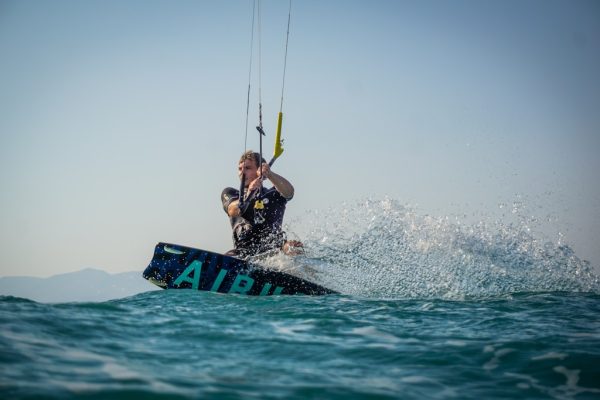
Koh Samui: the comfortable option with trade-offs
Samui operates on the same Gulf of Thailand wind calendar as Phangan — the North-East and South-West monsoons arrive at the same time, with similar strength and direction. The conditions on a given day are often comparable. Where Samui diverges is infrastructure and atmosphere.
The island is more developed, accommodation prices run higher, and the beaches near the main kite spots carry more boat and jet ski traffic than Phangan. Experienced riders who want resort-level comfort and are comfortable managing crowded water will find Samui workable. For newcomers to the sport, the trade-off is less favourable: more congestion in the riding zone, less forgiving water conditions close to shore, and a general pace that suits confident independents more than those working through their first board rides.
Samui does offer strong transport links and a wider range of accommodation, which can simplify logistics for travellers combining a kite trip with time elsewhere in the country.
Phuket: different sea, different conditions
Phuket sits on the Andaman Sea, not the Gulf of Thailand. That’s a meaningful distinction. The primary wind season runs May through October, driven by the southwest monsoon — essentially the opposite calendar to Phangan and Samui. If you’re planning a December-to-April trip and considering all three islands, Phuket is out of its main wind window while Phangan is in peak season.
When the Andaman wind is on, it’s strong. Gusts regularly exceed 20 to 25 knots, and the open ocean exposure means chop and swell are part of the picture. For wave riding and advanced wing foiling, that’s a feature. For someone learning kiteboarding for the first time, gusty conditions and broken water are obstacles, not assets.
Phuket’s beaches are busy and accommodation prices are high year-round. Infrastructure is polished. The scene is there. But it’s a different type of riding environment, suited to experienced riders who want power and variety rather than flat water and steady, predictable wind.
The side-by-side verdict
For beginners learning kitesurfing or wing foiling, Phangan is the clearest choice. Flat, shallow water, consistent North-East monsoon wind from November through April, low crowd levels, and certified instruction covering both disciplines in one place add up to conditions that genuinely accelerate learning. Price point is budget to mid-range, lower than either of the other two islands.
Samui shares the same wind calendar but trades Phangan’s open lagoon for busier water, more boat traffic, and higher accommodation costs. Wind quality on a given day can be comparable; the riding environment is less forgiving. Better suited to confident independents than to first-timers working through a structured course.
Phuket runs on a different season entirely — the Andaman southwest monsoon peaks May through October, while Phangan is in its strongest window December through April. When the wind is on in Phuket it’s powerful and gusty, with open ocean exposure and real swell. Experienced wave riders and advanced wing foilers find it compelling. For flat-water learning it’s the wrong environment, and the price level is the highest of the three.
The short version: choose Phangan if you’re learning, if you want flat-water foiling, or if you value uncrowded water over resort infrastructure. Choose Phuket if you’re an experienced rider after Andaman wave sessions in the May–October window. Choose Samui if comfort and transport links matter more than optimal learning conditions.
The honest summary: Phangan is the clearest choice for anyone learning kitesurfing or wing foiling for the first time, or for foil riders who want long flat-water sessions on consistent northeast wind. Phuket is the destination for experienced wave riders during the Andaman season. Samui sits in between — a serviceable kite destination with better resort infrastructure but busier water.
Getting to Phangan and what to expect on arrival
The island is accessible by ferry from Koh Samui in roughly 30 minutes, or by ferry from Surat Thani on the mainland in around 2.5 hours. Most international arrivals connect through Bangkok or Koh Samui. High season December through April is the peak travel window; booking accommodation in advance during January and February is advisable.
Kite Club sits directly on Thong Sala Beach. The setup is practical rather than elaborate: showers and changing facilities, Wi-Fi, a lounge area to decompress between sessions, beachboy support, and a storage space for riders who keep gear on the island between visits. The kitesurfing Beginner course runs 6 hours over 3 days at 11,000 THB including IKO certification and all gear. Wing foiling runs on the same structure — 6 hours over 3 days at 11,900 THB with IWO certification included. Both programmes cover equipment, instructor time, and international qualification in the course price.
If your dates are still flexible, January through March is the strongest window in terms of wind consistency and beach conditions. To check availability or ask about current conditions, the team is reachable on WhatsApp at +66 967203910.
Related Posts
You may also like
-
¿Qué significa haber entrado sin inspección? Todo lo que debes saber sobre la Green Card si entraste por frontera
-
Arizona Paper Wasps vs. Mud Daubers: Which One is the Real Threat?
-
Are Centipedes Dangerous to Deal with on Your Own in Groveland?
-
Does Mosquito Activity Increase Due to Weather in Indianapolis?
-
FRP vs Steel Grating: Which Lasts Longer in Harsh Environments?